
Background Information About Israel
Israel’s Spoken Languages
Holyland Private Tours By Ofir Horn
Israel’s Spoken Languages

The official languages of the State of Israel are Hebrew and Arabic. While not an official language, English is regarded as the main language for international communication and therefore is widely spoken by a majority of Israelis and it’s also heavily featured on most signposts as well as commercial products.
Spoken by six million Jewish people as well as other inhabitants of the land, Hebrew is the most common language. The next one is Arabic, which is common amongst over a million people, whether they’re Arabs, Jews who originate from an Arab country or people who have set out to learn the language. Israel is considered to be a melting pot due to the many immigrants who have populated it, additional languages can be heard among the various communities, with the most common ones being Russian (around 900,000 speakers), Jewish-Arabic (300,000) and Yiddish (200,000).
The Climate in Israel
Holyland Private Tours By Ofir Horn
The Climate in Israel

The climate in Israel is one of the country’s most pleasant surprises. Despite its small size — roughly the distance from Tel Aviv to Eilat is just 350 kilometers — Israel contains an extraordinary range of climates, from Mediterranean beaches to mountain snow to desert heat — making the climate in Israel unlike anywhere else in the region. Understanding the climate in Israel will help you plan the perfect trip.
Two Seasons: Dry and Rainy
Israel has two main seasons. The dry season runs from April to October — long, sunny days, virtually no rain, and warm to hot temperatures across the country. The rainy season runs from November to March, with most rainfall concentrated in January and February, primarily in the north and center of the country. Even in winter, Israel is mild by European and North American standards — cold spells are short, snow is rare outside the mountains, and the sun appears regularly between rain showers. For detailed forecasts, visit the Israel Meteorological Service.
Spring — The Best Time to Visit
March to May is widely considered the finest time to visit Israel. Temperatures are comfortable — around 18–25°C (64–77°F) across most of the country — wildflowers blanket the Galilee and Negev, and the landscape is lush and green after winter rains. Crowds are manageable outside of Passover week, and the light is ideal for photography. Spring is perfect for hiking, sightseeing in Jerusalem, and exploring the Sea of Galilee.
Summer — Hot, Dry, and Sunny
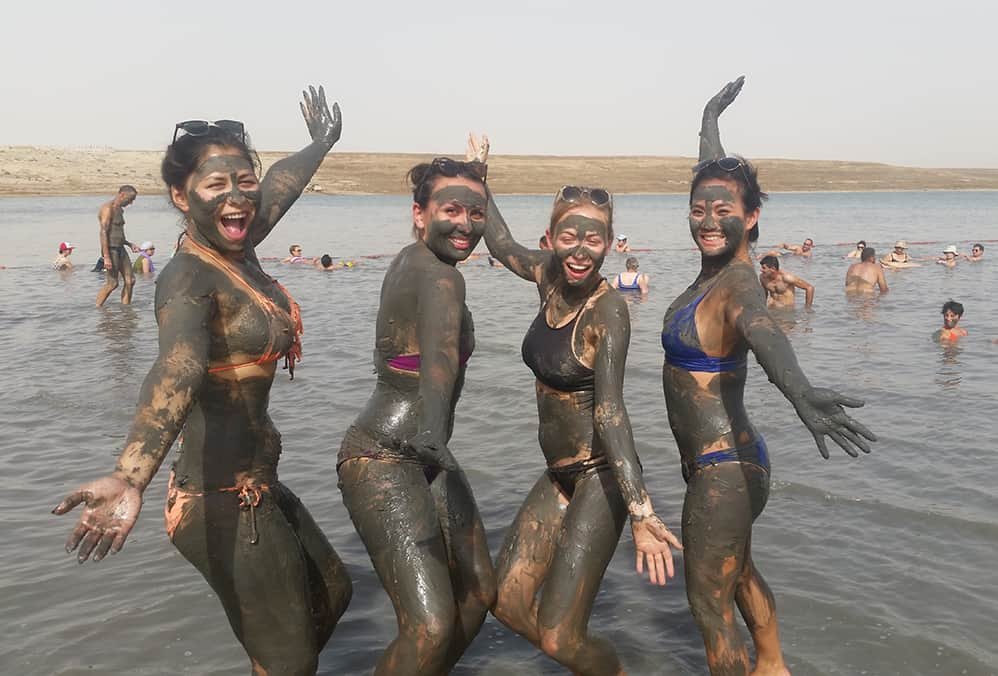
June to September brings intense sun and heat, especially inland and in the south. Tel Aviv and the coast average 28–32°C (82–90°F) with high humidity, while Jerusalem is a few degrees cooler and drier. The Negev and the Dead Sea region can exceed 40°C (104°F) in July and August. That said, summer is beach season — Tel Aviv’s coastline is at its best, Eilat on the Red Sea is ideal for diving and snorkeling, and summer evenings throughout the country are warm and lively. Mornings and evenings are the best times for outdoor sightseeing in summer.
Autumn — Warm, Dry, and Quiet
September to November is another excellent season for visiting. Temperatures cool from summer’s peak but remain warm and sunny — ideal for walking, touring, and outdoor activities. October and November offer some of the best conditions of the year: clear skies, comfortable temperatures of 20–28°C (68–82°F), and fewer crowds than spring. The sea remains warm enough for swimming well into October.
Winter — Mild and Uncrowded
December to February is Israel’s low season, and for some travelers, a hidden gem. While the north and Jerusalem see rain and occasional cold, winter temperatures rarely drop below 10°C (50°F) in most of the country. Eilat and the Dead Sea enjoy warm, sunny weather even in January. Crowds are thin, prices are lower, and the holy sites of Jerusalem, Bethlehem, and Nazareth feel especially atmospheric in the quiet winter months. Snow occasionally falls in Jerusalem — a magical sight, though it melts within a day or two.
Climate by Region
Israel’s varied geography means the climate in Israel differs significantly from one region to another:
Tel Aviv and the Coast: Mediterranean climate — hot, humid summers and mild, occasionally rainy winters. Pleasant year-round, with beaches accessible from May through October.
Jerusalem: Highland climate — slightly cooler and drier than the coast. Summers are warm but not oppressive; winters are cool and sometimes rainy, with rare snow.
The Galilee: Lush and green, the wettest region in Israel. Mild summers, cool winters, and the most rainfall in the country. Exceptional hiking and nature in spring.
The Dead Sea and Jordan Valley: Desert climate — extremely hot and dry in summer, warm and sunny in winter. The lowest point on earth, it has its own unique microclimate.
The Negev Desert: Arid and dramatic. Cool to cold winters, scorching summers. Best visited from October to April.
Eilat: Year-round sunshine, minimal rainfall, and warm Red Sea waters even in winter. A popular destination for diving, snorkeling, and beach holidays in any season.
When Should You Visit?
For most travelers, April–May and October–November offer the ideal combination of comfortable weather, manageable crowds, and beautiful scenery. Summer is perfect if beaches are your priority. Winter is ideal for budget travelers and those seeking a quieter, more meditative Holy Land experience.
Whatever season you choose, the climate in Israel ensures there is always a perfect time to visit — and Israel’s extraordinary history, landscape, and people make it a destination unlike any other. Contact us to plan your private tour around the perfect time for your visit.
Israel’s Population
Holyland Private Tours By Ofir Horn
Israel’s Population
Israel’s population reached a historic milestone at the start of 2026 — surpassing 10 million residents for the first time. According to Israel’s Central Bureau of Statistics, the country now counts 10.178 million people, a testament to decades of immigration, high birth rates, and relentless growth. Few countries of Israel’s size offer such extraordinary human diversity, and understanding the Israel population is key to understanding the country itself.
Israel Population in Numbers
As of early 2026, Israel’s population stands at 10.178 million — up from 9.1 million just a few years ago. Jews and others make up 76.3% of the population (approximately 7.771 million), Arab citizens account for 21.1% (2.147 million), and foreign nationals make up 2.6%. The country’s population grows at a rate of 1.1% per year, driven by approximately 182,000 births annually. Life expectancy is 82.7 years — well above the global average of 73.8 years.
A Young and Growing Nation
One of the most striking features of the Israel population is its youth. The median age is around 30 years — remarkably low for a developed economy, and a sharp contrast to aging populations across Europe. Israel’s fertility rate stands at 2.85 children per woman, well above the replacement level of 2.1, making it one of the only developed countries sustaining natural population growth. Since the State was founded in 1948, Israel’s population has grown more than tenfold — from under a million to over ten million today. For the latest figures, visit the Israel Central Bureau of Statistics.
Israel’s Jewish Community
The Jewish population of Israel is itself a mosaic. Since 1948, over 3 million Jewish immigrants have arrived from more than 130 countries, each wave leaving its mark on Israeli culture, cuisine, language, and society.
The major waves of immigration — known in Hebrew as Aliyah — include: 700,000 arrivals between 1948–1951 (doubling the population overnight); 350,000 from North Africa and Romania in the 1950s–60s; and nearly 900,000 from the former Soviet Union in the early 1990s, the largest single wave. An additional 60,000 arrived from Ethiopia through dramatic airlifts — Operation Moses and Operation Solomon — becoming one of the most moving chapters in modern Israeli history.
Today, 79.7% of Israeli Jews were born in Israel. Religious observance varies widely: Ultra-Orthodox (Haredi) Jews make up around 12% of the Jewish population, religious Jews 10%, traditional 35%, and secular Jews 43%.
Israel’s Arab Citizens
Arab citizens form the largest non-Jewish group in Israel, comprising about 21% of the total Israel population. Most live in Arab towns and villages across the Galilee, the coastal plain, and the northern Negev. They are also well-represented in mixed cities such as Jerusalem, Haifa, Akko, and Ramle.
The majority of Arab citizens are Sunni Muslim. About 10% are Christian Arabs, mostly Greek Orthodox. The Bedouin — Muslim Arabs with a traditional nomadic heritage — now live primarily in permanent communities in the northern Negev.
The Druze
The Druze are a unique community whose faith developed from Shia Islam in the 11th century. Around 145,000 Druze live in Israel today, concentrated in 17 villages on Mount Carmel, in the Galilee, and on the Golan Heights. The Druze maintain a proud tradition of service in the Israeli military and are known for their fierce loyalty to the State of Israel.
The Circassians
A small but distinctive community, the Circassians are Muslim but ethnically non-Arab, originating from the Caucasus region. When Russia conquered their homeland in the 19th century, many fled to the Ottoman Empire — and some settled in the Land of Israel. Today, approximately 4,000 Circassians live in the villages of Kfar Kama and Rehaniya in the Galilee.
The Samaritans
One of the world’s oldest and smallest religious communities, the Samaritans trace their origins to the ancient Kingdom of Israel. Following the Assyrian conquest in 722 BC, those who remained in the land developed a distinct identity, preserving an ancient form of the Torah. Today, only about 800 Samaritans remain in the world, divided between the city of Nablus (in the Palestinian Authority) and Holon, near Tel Aviv.
Where Israelis Live
Israel is a highly urbanized country — over 91% of its population lives in cities and towns. About a quarter of the population lives in one of the four major cities: Jerusalem (the capital, with over 980,000 residents in the city proper), Tel Aviv, Haifa, and Rishon LeZion. The greater Tel Aviv metropolitan area is home to over 4 million people — roughly 40% of the entire Israel population.
Two agricultural settlement forms unique to Israel are the kibbutz (a communal settlement based on shared ownership) and the moshav (a cooperative farming village combining private ownership with collective support). Both have undergone major reforms since the 1990s, with most kibbutzim partially privatized today.
A Nation of Immigrants — and a Land for Visitors
Israel’s extraordinary demographic story — ancient roots, dramatic returns, and ongoing renewal — is part of what makes visiting the country so compelling. Every community you encounter on a tour of Israel carries a unique history and a living culture. Contact us to plan a private tour and meet the people who make this land unlike any other.